

By Matt Finch
If social impact means creating long-term change, then we face a difficult problem: we live in turbulent times, and the future in which our impact will unfold is deeply uncertain.
Individuals, communities, institutions, and societies are witnessing the erosion of old certainties. Social and technological developments, geopolitical shifts, and the changing climate affect us at every level from the global to the local, and it is far from clear how these factors will play out.
On top of this, impact isn’t instant. The ongoing consequences of today’s decisions will inhabit a time that is yet to arrive, and our beliefs about what actions will make a real difference are entangled with the assumptions we hold about our environment.
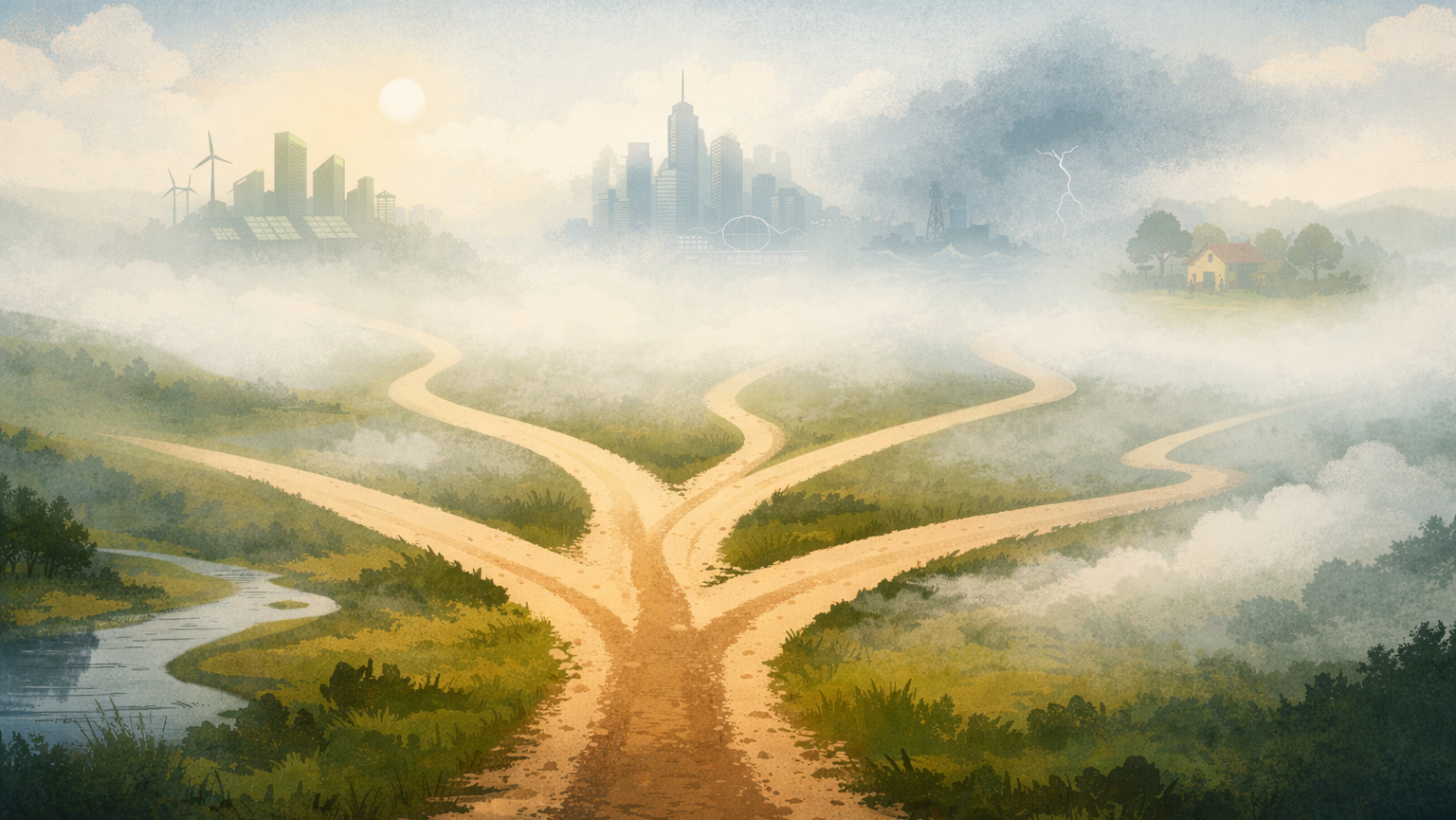
For those of us who seek to address social problems, scenario planning can help. This foresight technique involves the development of multiple plausible and contrasting futures, relevant to current concerns but challenging to our assumptions. Building and using scenarios offers the opportunity to critically explore expectations, hopes, and fears about the world within which we hope to make an impact.
Looking for the futures you didn’t see coming
Under the “TUNA” conditions of Turbulence, Uncertainty, Novelty, and Ambiguity, we can’t be sure that what happens tomorrow will look anything like yesterday or today. We can’t even have confidence that the assumptions underpinning our predictive models will hold. This is exacerbated by the fact that you can’t gather data or evidence from events which haven’t happened yet, so merely “running the numbers” won’t help us much.
Scenario work addresses this by looking beyond prediction and forecasting. The aim is not to correctly identify one future that will happen, or assign probabilities to different future circumstances. Rather, scenarios expand our sense of what may happen, dismantling our preconceptions and giving us the chance to examine the uncertain present from new perspectives. Researchers George Burt and Anup Karath Nair refer to this as “unlearning”; temporarily suspending our current beliefs to see what else might come to pass.
When we build scenarios, we’re also not seeking to express a desired future. Recognising that we are not all-knowing and all-powerful, that some forces and events may remain out of our control, we acknowledge and embrace uncertainty. That doesn’t mean we surrender our agency; indeed, this acceptance forms the first step towards wise action in unpredictable times.
In the Oxford Scenario Planning Approach developed at the Saïd Business School, scenario builders create a map of their environment, comprising the “island” of relationships which they currently inhabit and a surrounding “sea” of present-day uncertainties. These uncertainties are factors, forces, and trends which lie beyond their control and yet may reshape life on the island by coming ashore in different ways. The art of good scenario planning lies in finding rich and useful answers to the question, “What if the sea of uncertainty came ashore in ways we didn’t expect?”
The case of Norwegian schools
In 2019, the University of Oslo convened a project on the future of screen technologies in education, seeking to consider how digital media might be deployed in times to come. The “island” of the typical Norwegian school at the end of the 2010s was much as it had been for decades. Headteachers led the school, dealing with staff, students, parents, unions, government and municipal departments, textbooks and information technology suppliers, and maintenance services for school buildings and classrooms – among many others.
Yet factors in the sea of uncertainty were waiting to come ashore: technological developments in the classroom, the arrival of social media, and shifts in the balance of public and private sector players in education. The Oslo researchers collaborated with officials, teachers, representatives of tech companies, and civil society bodies to imagine how their island might change in times to come. In order to fully consider the impact of these uncertainties, they set their scenarios in the year 2050.
These visions, not utopian or dystopian but challenging to current assumptions, showed worlds in which children self-educated in privatised virtual environments; where parents battled with educational bodies over who was responsible for health and wellbeing when kids were learning from home; where an oil crisis shook the Norwegian economy, with ramifications for the education system, its politics, and funding.
The scenarios were published in March 2020, just as Norway experienced its first COVID cases. Within a matter of months, circumstances which had been foreseen on a thirty-year time horizon came to pass. Children and young people studying from home had to take more responsibility for their learning, as Microsoft Teams became the most significant educational venue in the country. Parents argued with institutions over lockdowns and vaccinations as doubt was sown over what was best for children’s wellbeing. Finally, the economic shocks of COVID-19, including the slowing of the oil market, caused Norway to engage in public spending at a scale unprecedented in peacetime, breaking a self-imposed cap on the nation’s sovereign wealth fund.
None of this was prediction in the conventional sense, because the scenarios were set in 2050. Instead, it was a successful expansion of people’s sense of what might transpire, taking additional uncertainties into account. This is what scenario scholars Trudi Lang and Richard Whittington call “taking the broad view, not the long view”.
After the scenarios were published, their users had the unnerving but valuable sense of contemporary uncertainties coming to life. “2050 was last year,” said one ruefully. But this experience of the world becoming unfamiliar can help us think about what we mean by “the long term”.
Thinking more broadly than risk and threat
If impact consists of long-term changes in people’s lives and the environment, we need to also test our assumptions about how much time things will take to play out. The largely unforeseen rapid uptake of working from home during COVID-19 lockdowns, as well as the exponentially growing transmission of the infectious disease itself, reminded us that the future may sometimes arrive sooner than anticipated. Dornbusch’s Law, named for the economist Rüdiger Dornbusch, reminds us that crises can seem to happen little by little, then all at once; they may take longer to arrive than we think, but then play out faster than expected.
Infectious disease medic and researcher Gail Carson was a senior leader of the World Health Organization-affiliated Global Outbreak Alert and Response Network during the pandemic. She led the construction of scenarios to inform infectious disease response, as well as contributing to the European Commission-funded IMAJINE scenarios project which looked at regional inequality.
She told IMAJINE: “The hit of the pandemic showed up all the weaknesses of the system…Looking at these scenarios can identify systemic weaknesses before we have to endure the next hit; doing that work of identification and early intervention would be an honourable thing to do.”
That’s not to say that scenarios are always about risk, threat, and bad news. On the contrary, we lay aside calculable risk because uncertainty, by definition, is incalculable. At the same time, we recognise that what is light and dark in a given scenario depends on where you stand. What is good for one may not be good for another, especially in retrospect, and “best” or “worst-case” scenarios are always in the eye of the beholder.
The power of manufactured hindsight
Mature scenario work invites hindsight, asking not just “Which future do I think I want?”, but also “How will each future judge the decisions I make today?”
It gives us the humility to ask, “What might the future consider impactful in hindsight?”, and use different possible answers to inform wise decision-making.
The Peat Hub Ireland project, funded by the Irish Environmental Protection Agency and led by researchers from University College Dublin, included a scenario element which brought together institutions, organizations, and communities involved with peatlands.
A positive vision for peatlands custodianship had already been developed, comprising public awareness, active management, integration of climate impacts, favourable conservation status for wetlands, and an approach of “restoration, regrowth, and rehabilitation.”
The scenarios allowed a range of people and institutions to discuss and debate how this vision might be realised in alternate futures where different priorities, principles, values, and problems might arise. These ranged from the environmental impact and private-sector pressures of cloud computing to politically fractious futures where wetlands custodianship might be derided as “woke”, or other worlds where sustainability was embraced, elevated, and enforced above all other priorities.
As one Peat Hub scenarios participant put it, “what I liked most was getting to experience a framework for discourse between different stakeholders where everyone was approaching challenging ideas with an amount of vulnerability and openness.”
Peat Hub Ireland’s Florence Renou-Wilson explained, “While synthesizing 20+ years of research is a critical foundation for policy, it is inevitably biased. By incorporating foresight and scenario planning, the Peat Hub Ireland project allowed stakeholders to adopt a broader view of potential outcomes. This approach moves beyond the limits of traditional ‘literature review’ by engaging in conversation all the stakeholders and their different perspective and values. This ensures that the resulting sustainable management roadmap for peatlands is based on wise actions that remain robust across multiple plausible futures.”
From hindsight to impact metrics
Peat Hub Ireland’s scenarios also drew on the IMAJINE project’s Europe-wide set of scenarios looking at regional inequality in times to come.
IMAJINE researcher Marie Mahon, Professor of Human Geography at the University of Galway, later explained, “We went into this project looking for new measures and metrics, only to find the real, deeper question was about what we’re going to value in times to come.”
Scenarios can inform the design of impact metrics which embody these deeper values by considering the question: What might future generations wish we had measured in hindsight?
As we consider what inhabitants of each scenario might value, we can then identify and design appropriate impact measures to implement today.
The philosopher of science Jerome Ravetz suggests six principles to underpin the design of such metrics:
- Relevance – how well do they meet the needs of users?
- Accuracy – how well do the measures describe reality?
- Timeliness – how quickly do the measures become available?
- Accessibility and clarity – how easy to obtain and how understandable are the measures?
- Comparability – how easy is it to compare different geographies, sectors, or time periods within the same data set?
- Coherence – how easy is it to combine the data in different ways and for different uses?
These criteria can help us think through what impacts we want to measure, how we’ll measure them, and why. The measures we develop today will accumulate data and become gifts to the future – however the uncertainties play out and whatever comes to pass.
Even and especially when we can’t be sure what tomorrow holds, the opportunity still stands to make real change. As we reflect on the many uncertainties which surround us, we may consider the limits of our ability to dictate what will happen, but we still recognise the need not to give up, and to act in good faith with whatever agency we have.
This is the true value of scenario work: not predicting the future, but helping us make wiser decisions about impact today, even in the most turbulent times.
Matt Finch is a practitioner and researcher in the fields of strategy, negotiation, and foresight. He is an Associate Fellow at Saïd Business School, University of Oxford and an adviser to the UK All-Party Parliamentary Group for Future Generations.


