

If there is one thing you cannot accuse Elon Musk of, it is a lack of imagination.
He has described a future of self-driving cars, artificial intelligence, robots and colonies on Mars – and has managed to attract enormous amounts of capital, talent and attention to his visions.
For British biologist and systems thinker Phoebe Tickell, Elon Musk is more than a powerful billionaire. He is an example of who has been allowed to describe the future today – and of the values our economic system rewards.
“We can see Elon Musk or Donald Trump as products of the dominant system. The reason they do so well is that we have a system that rewards people who think that way,” she says.
Behind these powerful individuals lies a structure that directs capital, influence and recognition in particular directions, Phoebe Tickell continues. And we accept that far too readily.
“The big mistake is that we reward them. If our system rewards people who threaten life on Earth, then it is the system that needs to change,” she says.
This is where imagination comes in. If the system is made by people, it is not a law of nature. It can be arranged differently. But that requires us to imagine a future as compelling as Elon Musk’s.
The Contest for an Appealing Future
I meet Phoebe Tickell at Thoravej 29, a community of organizations in Copenhagen working to create “far-reaching positive change for people and society.”
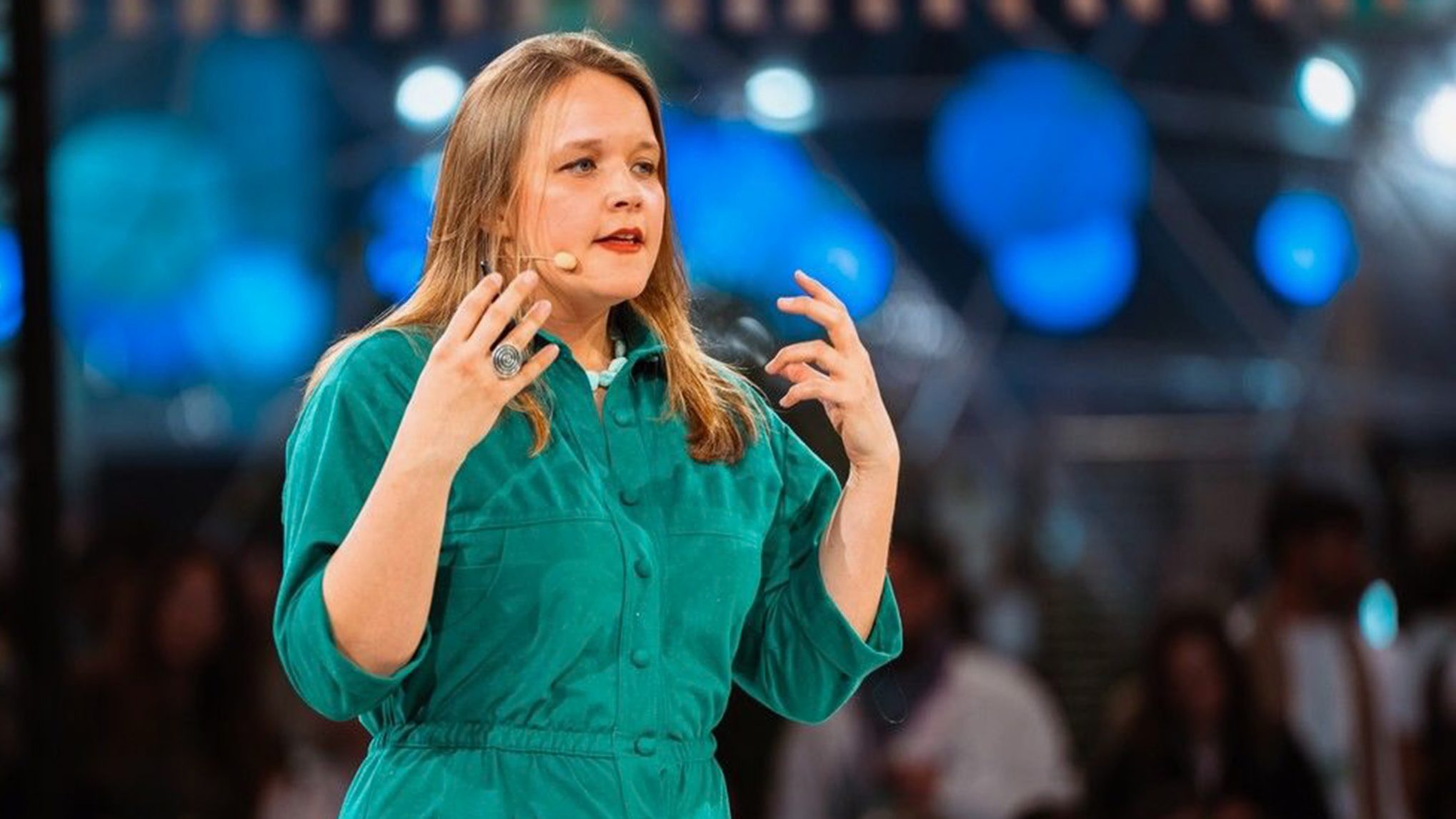
She is here to speak at a summit on Imagination Activism. She founded the organization Moral Imaginations and calls herself an imagination activist – a term that holds considerable potential.
The Article in Brief
* Power shapes the future. Today, the ultra-rich have the capital, influence and attention to put their visions at the center.
* The system can be changed. It is human-made, which means it can be reshaped to reward different values and visions.
* Imagination activism goes beyond critique. It uses imagination collectively and deliberately to develop concrete ideas about what to build instead.
* It brings together three approaches: the activist’s heart, the artist’s mindset and scientific rigor. The aim is to imagine futures grounded in equality, justice, cooperation and joy.
For Phoebe Tickell, imagination activism is “the conscious and collective use of imagination to create systemic change.”
“I often describe it through three perspectives,” she says.
“You need the activist’s heart, the artist’s mindset and the scientist’s rigor. It is the combination of the three that we need to transform society for the better.”
According to Phoebe Tickell, traditional activism has brought about some of the greatest advances in social and environmental justice over the past few centuries.
It can identify injustice, build countervailing power and press existing systems to make concessions. But traditional activism has its limits.
“It can show us what is not working, but often fails to paint a compelling vision of a future that works for everyone. Imagination activism is about identifying, in concrete detail, what we need to build instead,” Phoebe Tickell says.
And that is precisely what ultrarich visionaries such as Elon Musk are able to do. They know how to sketch a future that gets investors, engineers and politicians to rally behind their projects.
Phoebe Tickell sees a longing for strong, compelling stories about a positive future.
“There is a silent majority of ordinary people sitting there doomscrolling on their phones, deeply worried about the future, but not feeling that they have the answers, the solutions or perhaps the vision of a better alternative,” she says.
The absence of positive alternatives breeds apathy, despair and, in the worst case, nihilism, Phoebe Tickell points out.
“But if better solutions and alternatives exist, we can begin to build a political movement for real change,” she says.
Activist or Consultant?
But what is actually activist about helping organizations and local authorities imagine the future, I ask Phoebe Tickell. Is it not simply values-driven consulting?
“Oh God, no,” she replies immediately.
“Consulting starts from an organization’s needs and wishes. Imagination activism is about what benefits society as a whole,” she explains, then continues:
“It may not benefit certain organizations to create a world that works for everyone. It may not benefit companies that want to sell sugary soft drinks if every child has access to clean, fresh water.”
She stresses that she does not offer a ready-made recipe for the good society.
“I am not trying to persuade anyone that my answers about what the world should look like are the right ones,” she says.
And yet:
“I am saying that everyone needs to train their moral imagination—an imagination grounded in equality, unity, social and environmental justice, collaboration and joy.”
So this is not a value-neutral process. Although Phoebe Tickell does not have a finished design for the buildings, transport systems or economy of the future, the work rests on clear moral principles.
“It is the job of science to investigate what actually works within the physical and material constraints. The artist’s mind needs to think creatively and imaginatively. And the activist’s heart must be driven by justice for all human and non-human living beings,” Phoebe Tickell says.
She stresses that the approach should be experimental and exploratory, and not tied to a particular ideology. At the same time, her analysis is clearly political: the dominant visions of the future are shaped by an economy that channels the gains upwards.
“Our current economic system runs on a capitalist imagination that is fundamentally elitist. It is a vision of a hierarchical world, a pyramid where only those at the top reap the benefits, while everyone else’s efforts move upwards,” Phoebe Tickell says.
Humanity has the technology and resources needed to give far more people a good life. So when that does not happen today, the issue is one of distribution, values and imagination.
“We have the resources. What we lack is the moral imagination to use them to make the world better today,” she says.
First, We Need to Understand Where We Are
Phoebe Tickell’s critique reaches back to the ways of understanding the world associated with the Enlightenment and industrialization.
We have made great advances that we now take for granted in modern medicine, education and social security. But those same patterns of thought have also contributed to colonization, the destruction of nature and the idea of humanity as the crown of creation.
“We need to see ourselves again as part of the web of life. We should not see humans as at the top of the food chain, elevated above all other species and entitled to dominate them, but as part of an interconnected whole,” Phoebe Tickell says.
That is why imagination activism does not begin with a creative workshop in which participants freely invent ideal scenarios. It begins by understanding the present so that we can shape the future.
Moral Imaginations works in four stages.
The first is to understand the existing system: What is happening? How did we get here? What historical conditions created the current situation?
In the next stage, participants make room for the emotions the problems evoke: anger, fear, confusion, apathy or numbness.
“People need space to connect with the emotions that, in some cases, prevent them from imagining a better future. That is especially true when we are dealing with very large, long-term crises or suffering on a massive scale,” Phoebe Tickell says.
Only in the third stage is the moral imagination activated. Participants might, for example, try to see the future from the perspective of generations to come, or have people represent animals, plants and other non-human actors in an ecosystem.
The fourth stage is about action.
“We take the insights, ideas and new perspectives from the first three parts of the process and work backwards to make them real,” Phoebe Tickell explains.
If, for example, the vision is a future library built around care as a fundamental principle, participants must describe what that would look like in practice. They then examine what is preventing it from becoming reality today and what could remove those obstacles.
“It is a way of working backwards from the future to the present, and then creating a strategic plan from the present toward that future,” she says.
It is important to analyze problems for long enough, and thoroughly enough, to understand them – but not for so long that we lose the ability to act.
“We need both imagination and action. If we only imagine and never act, nothing happens. But if we act without imagination, we simply recreate yesterday’s problems,” Phoebe Tickell says.
When the Borough Asked: What If?
In the London borough of Camden, Moral Imaginations has run an eight-week program for 30 local authority employees.
They were trained as internal ambassadors for moral imagination, and each had to turn their vision for Camden in 2030 into concrete projects.
Phoebe Tickell says that one employee in social services developed a system of so-called wellbeing passports, which was later rolled out across the borough. Others began holding weekly “what if” meetings, where staff and residents could ask questions such as: What if Camden were waste-free? What if Camden ended homelessness? What if the borough grew its own food?
The head of the borough’s library service involved local residents in imagining the future of its nine libraries. They described the libraries as centers for care, mutual learning and cultural exchange. Those visions were turned into a strategy.
Phoebe Tickell argues that when local authority employees focus on tomorrow’s problems or next year’s budget instead of looking further ahead, it is rarely because they lack good intentions. They lack time, space, permission and training.
“We should not spend all our time thinking seven generations ahead,” Phoebe Tickell says.
“But if we spend just ten percent of our time thinking further ahead, we can create solutions that solve several problems at once.”
The Hard Part Is Measuring Systems Change
The Camden example shows that imagination activism can create new activities, methods and strategies and spread through a large organization.
It is harder to document whether the approach has also improved housing, reduced homelessness or produced lasting systemic results.
According to Phoebe Tickell, Moral Imaginations evaluates both participants’ sense of agency and changes in their mindsets. After two weeks, two months and six months, the organization also asks what projects, actions and decisions the programs have led to.
But the longer chains of causation are difficult to trace. Phoebe Tickell compares this with mentoring, where the overall effect on a person’s life or career can be substantial without being easy to isolate and measure.
“In the same way, it ought to be possible to conduct studies that follow participants over time: Have people acted in ways that are better for the planet and the future? Have they created more systemic change after learning this approach than they would have without it?”
The fact that strong, long-term evidence is not yet available does not mean the method has no effect. But for now, there is better evidence that it shifts participants’ perspectives and sense of agency than that it produces genuine systems change.
Do You Ever Doubt?
Phoebe Tickell’s project is enormous. She imagines universities as incubators for moral imagination, schools with far more room for creativity, politicians working with citizens to formulate visions of the future, and technology companies acting as stewards of intelligence in order to create better futures.
Just as Elon Musk mobilizes people behind his mission, Phoebe Tickell wants to create a vision compelling enough to mobilize researchers, economists, politicians, technologists and ordinary people around the world.
“We need everyone for this planetary mission. We must choose to create a world that works for everyone – not because it is easy, but because it is hard,” she says.
I ask whether she ever doubts that this can happen. Whether encounters with war, ecological destruction and the powerful interests she wants to challenge sometimes make her lose faith.
“No.”
The answer comes quickly and without hesitation.
“It is simply the only thing that makes sense to me. As a scientist and a long-term thinker, I believe anything less will put the survival of humanity at risk. There is no other solution than to rethink the way we live on Earth,” she says.
For Phoebe Tickell, this is a matter of logic – almost of causality.
“I have thought it through. I have been researching this for ten years. I am a biologist and a systems thinker, and I trust my ability to read graphs, understand data and examine historical movements. I am convinced this is what we need,” Phoebe Tickell says.
She does not claim to have all the answers about how the visions should be put into practice. That, she says, is precisely where humanity’s different experiences and forms of intelligence need to come into play.
But she does not doubt the direction.
I point out that Elon Musk, Donald Trump and others are making great efforts to move the world in the opposite direction. But Phoebe Tickell refuses to give them the leading role in the story of the future. They are central, but their imagination is constrained by the logic within which they operate.
“We have a system that rewards people who think that way,” she says.
So what you are saying – at least implicitly – is that because we created the system, we can create a new one too?
“Absolutely.”


