

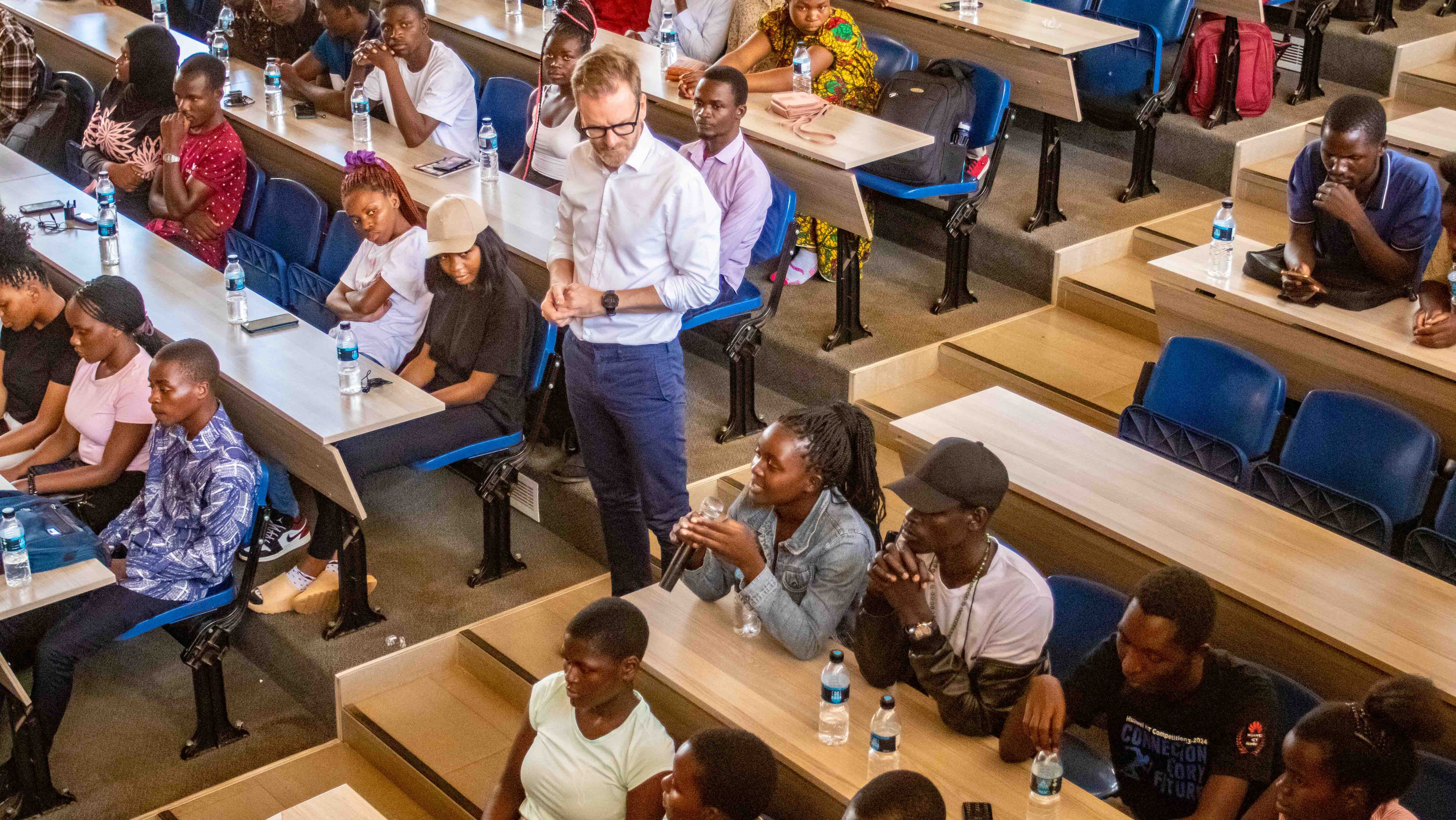
“We are all born with the same potential. But we don’t all have the same opportunities.”
It’s a sentence Jimmy Scavenius has repeated countless times over the past ten years. Yet, the words feel anything but worn when he says them at Risteriet café on Helgolandsgade on a grey November day.
For Jimmy, this isn’t just a catchphrase. It’s the air he breathes in his company, Kwera—a word that, in the African language Chichewa, means “to rise.”
And rising is exactly what Jimmy facilitates through Kwera, which helps young people in Malawi, a southeastern African country, gain higher education and find employment.
“There is so much potential in Africa. That’s where I can create the most impact with my passion and knowledge,” says Jimmy.
He pursues that impact with an advanced business model and a laser-sharp focus on improving the lives of young Africans—and, ideally, transforming entire communities.
Now, after establishing a foothold in Malawi, he is expanding to Tanzania and eventually a third African country. For this, he needs funding: $15 million, or just over 100 million Danish kroner.
Some of that money will come from investors. Some from philanthropists. This makes Jimmy a frontrunner in a financial discipline gaining traction: blended finance.
This strategic cocktail of philanthropy and business is set to help Jimmy achieve his goal of providing education to one million Africans.

A Sustainable Model
Six out of ten people in Africa are under 25, making it the youngest continent in the world and brimming with human potential.
According to consulting firm McKinsey, African countries are expected to contribute nearly 800 million people to the global workforce by 2050.
Unlocking that potential, however, requires more young people to complete higher education. In Malawi, only 1% of the population goes beyond high school. And this is where Jimmy Scavenius comes into the picture.
Kwera funds bachelor’s degrees for young people who otherwise couldn’t afford to attend university. The brilliance of the model is that it becomes self-sustaining once it’s up and running.
A year after completing their education, Kwera’s students begin repaying a percentage of their income—provided they’ve found employment.
Since they repay more than they received, they help fund education for an ever-growing number of students.
This makes Kwera’s impact model financially sustainable—assuming the students complete their studies and secure jobs afterward.
And so far, they do.
The Six Pillars of Kwera
1. Selecting Students with Potential
Kwera identifies students with significant academic and personal potential. This is achieved through partnerships with local authorities such as the National Council for Higher Education in Malawi and local schools. Former students also play a vital role, visiting their old schools to actively recruit new candidates. This ensures the program reaches youth in remote and underserved areas.
2. Income Share Agreements (ISAs)
Kwera covers students’ tuition costs upfront through an economic agreement. Once they graduate and secure jobs, they repay a percentage of their income over a limited period. This model ensures students don’t incur unmanageable debt while allowing Kwera to reinvest funds in new students. The agreement includes a cap to protect students from excessive repayment demands.
3. Customized Online Competency Program
Kwera’s four-year Core Skills program equips students with life and workforce-relevant skills. It covers areas like self-management, teamwork, communication, innovation, and entrepreneurship. The goal is to make students more competitive and capable of creating value in their communities, whether in existing organizations or through starting their own businesses.
4. Kwera Communities on Campus
To foster a sense of belonging, Kwera encourages students to organize into self-governing communities. These groups serve as support networks where students can share experiences, offer practical help, and feel part of something larger. These communities enhance mental well-being and social connectivity.
5. Job Creation and Placement
Kwera actively works to ensure its graduates secure relevant jobs post-graduation. This involves partnerships with companies, building connections with the job market, and supporting entrepreneurship. The focus is not just on finding jobs but creating opportunities that align with students’ skills and ambitions.
6. A Strong Alumni Network
After graduation, former students remain part of Kwera’s community. This alumni network serves as a resource for new students and allows graduates to give back through mentoring, guidance, and financial support. The network also provides role models who inspire new generations and contribute to systemic change in their communities.
Why Are We Here?
We’ll get to the early but promising results. First, we need to understand Kwera’s origin story.
In 2012, Jimmy Scavenius traveled to Switzerland to pursue an Executive MBA at one of the world’s most prestigious business schools, IMD in Lausanne.
After years as a lawyer at Plesner—one of Denmark’s largest and most renowned law firms—he had recently transitioned to Financial Stability, the state entity established to guide the banking sector and society safely through the financial crisis.
In Switzerland, Jimmy was determined to sharpen his skills in classic business disciplines like strategy, finance, and marketing.
But one day, during a lecture, Professor Jean-Pierre Lehmann posed a question: “What’s it all for?”
That question sparked something in Jimmy. What was the purpose of all our growth and prosperity?
“I remember thinking: ‘Wow, he’s right. Why are we even here?’” Jimmy recalls.
He went to Mozambique to collect data for his thesis—a business plan for Kwera.
When he returned to Denmark, he paid off his student loans. Then he sold his apartment in Gothersgade, his car, and the rest of his possessions. By spring 2015, Jimmy had left his legal career behind.
The Breaking Point
Jimmy Scavenius arrived in Malawi on a tourist visa.
He brought with him all the money he had managed to save, investing it into his mission.
In 2017, 20 young people began studying at some of Malawi’s best universities—funded by Jimmy’s savings and support from his brother. This was Kwera’s first cohort.
Jimmy felt that something big and meaningful was starting. In 2019, he returned to Denmark and began fundraising through his network.
He tried adding a donation button on Kwera’s website.
“I thought people would just go in and donate a million. I was convinced because I thought the idea was brilliant,” Jimmy says.
But in the first week, the only donation was 500 kroner from his wife Paula’s Brazilian family.
This marked the beginning of a tough time. It strained Jimmy’s finances, and he barely managed to raise enough for 14 new students, Kwera’s second cohort.
There was no money left to pay himself a salary. Jimmy and Paula stayed with friends and family, living off her modest income.
“And by February 2021, I was completely broken. It was hell,” Jimmy says.
A Staggering Social Return
Then, in spring 2021, something changed.
The first students graduated. They had already been in the middle of their studies when they entered Kwera’s program. Now, they left university and quickly found jobs.
In March, Jimmy Scavenius received a global leadership award.
Now, Jimmy had concrete results to present—and there was interest in hearing about them.
Armed with these successes, Jimmy managed to attract investors.
One of these investors is businessman Thomas Kvorning, a former partner at the Nordic private equity firm Altor Equity Partners. He also holds a broad portfolio of board positions.
Thomas Kvorning and his wife had already financed education for children in Kenya when he met Jimmy. However, he had never before encountered a program aimed at adult students. The potential of Kwera quickly became clear to him.
“What does it take to transform a society? One of the most important components is achieving a critical mass of highly skilled young people. And it resonated with me to try this approach,” Thomas Kvorning says.
“There must inherently be impact in investing in education,” he notes.
“My clear belief is that the societal return on investment is staggeringly high compared to the relatively low cost of educating a student.”
At the same time, Thomas Kvorning was impressed by Kwera’s business model.
“It’s essentially a financial product wrapped in philanthropy,” he says, adding that this was a key reason why he is now a member of Kwera’s board.
“After 20 years in the financial industry, I was looking for an activity where I could provide direct help, rather than just passively delivering philanthropic funds. And I could quickly see that Jimmy could make great use of my expertise,” says Thomas Kvorning.
A Scalable Model
Another Kwera investor is Morten Hummelmose. He was a partner at EQT and benefited from the value increase that occurred when the private equity firm went public in 2019.
Today, Morten Hummelmose invests in real estate, among other things. He and his wife, Nanna, have also been deeply involved in philanthropy for years, formalizing their efforts in 2024 with the establishment of the Frececo Foundation.
Morten highlights Kwera’s income-based repayment model as a standout feature.
“It’s crucial that the students complete their education, and I believe this model creates accountability. It helps identify students who have what it takes to succeed—and who will actually repay the loan,” says Morten Hummelmose.
The couple’s investment in Kwera is philanthropic, he explains.
“We felt it was more important that the funds repaid by students be used to bring more into the system than for us to get our money back,” Morten Hummelmose says.
Still, Kwera’s sustainable and scalable business model played a role in their decision.
“Kwera has the potential to become financially sustainable in the long run, though it may take many years. And the concept is scalable,” Morten Hummelmose says.
“If it works in Malawi, there’s no real reason it wouldn’t work elsewhere.”

Ready for Growth
Today, 56 students have graduated with Kwera’s support. Within their first year after graduation, three-quarters of them have found employment, and all are repaying their loans.
The numbers are small, so it’s still too early to declare Kwera a proven concept.
“But we have enough indications that it works,” says Lykke Kann Ogstrup Lunde, chair of the Velux Foundation and a member of Kwera’s board.
“Our concept is a long-term investment, where the first students must complete university, find jobs, and repay their loans. And when they’ve done that, cohorts two and three must do the same. Only then will we have enough critical mass and empirical data to build on,” says Lykke Kann Ogstrup Lunde.
“But at this point, we have enough to seek further investments so we can grow.”
The Missing Links
The innovative financial model has been further developed in collaboration with Lars Rhod Søndergaard, a partner at the global accounting and advisory firm EY.
Lars worked with Jimmy at Financial Stability, where mutual trust was established. So, when Jimmy presented the idea for Kwera, Lars offered his expertise and network.
“Jimmy has a lot of knowledge and ideas, but he needed people with the skills we have — young professionals he could draw on,” says Lars.
It was a perfect match with EY’s global corporate volunteering program, which aims to impact one billion lives by 2030.
“So, we’ve helped Kwera with financial management, accounting, data usage, and building a solid financial model and investment prospectus,” Lars says.
Blending the Funds
Now, Jimmy Scavenius is fundraising.
Currently, Kwera supports around 1,300 students, most in their first two years of study.
The plan is to raise $15 million to support 5,500 students in Malawi, Tanzania, and a third, yet-to-be-determined country.
And this is where blended finance comes into play.
“I want to blend the money,” Jimmy says.
Blended finance has traditionally been used to mobilize private investments for projects in developing countries—typically in areas such as sustainable energy and infrastructure. However, awareness of the concept remains limited.
Now, there is growing attention on blended finance, particularly as a tool to accelerate the green transition.
In impact circles, blended finance is seen as a kind of universal key that can unlock far greater private capital flows.
In its 2024 market analysis, the Global Impact Investing Network (GIIN) states that “the use of blended finance is becoming increasingly relevant within the impact investing ecosystem—particularly in addressing some of the world’s greatest challenges.”
Here in Denmark, Invest for Impact Denmark calls blended finance “a critical catalyst for growth in impact investments.”
We Can Get More on Board
For Jimmy, the goal is to raise $3 million in philanthropic capital, $4 million in public funds, and $8 million from impact investors.
With the philanthropic base, Jimmy can reduce some of the risks for other investors. The investment funds can be tranched, allowing private investors to recoup their money first, and offering varying returns depending on the type of capital.
This approach is perfect for Kwera, according to Lykke Kann Ogstrup Lunde.
“It means you take some of the risk out, which makes it easier to get more people on board. We can simply attract risk-willing capital faster because everyone looks at each other and says, ‘Okay, if you’re in, then we’ll join too,’” she explains.
Lars Rhod Søndergaard from EY agrees.
“As I understand the appetite for investment, Kwera’s success doesn’t hinge entirely on whether the funds are raised through blended finance. But it is an additional accelerator that makes the shift Kwera is aiming for possible,” he says.
This will succeed
If Jimmy Scavenius’s plan holds, he will have raised $15 million by the first quarter of 2025, allowing new students in Malawi and Tanzania to begin their studies by autumn.
“This will succeed,” Jimmy says.
That statement carries more than just optimism — it’s a moral imperative: It must succeed.
“Africa will be the growth engine of the world. One-third of the global youth population will come from Africa. So, we simply need more people with higher education,” says Jimmy.
He lists the myriad benefits of higher education—for individuals and society.
“They pay taxes. They put less strain on healthcare. Birth rates decline. They’ll have a significantly better understanding of climate change,” he says, adding that they become role models.
“Someone will look at Kholiwe and say, ‘She dreamed of becoming a doctor, and now she is one. If she can do it, so can I.’”
Jimmy Scavenius pauses.
“Imagine the effect that could have on a family, a village, an entire society.”
He’s right, you know. This must succeed.


