

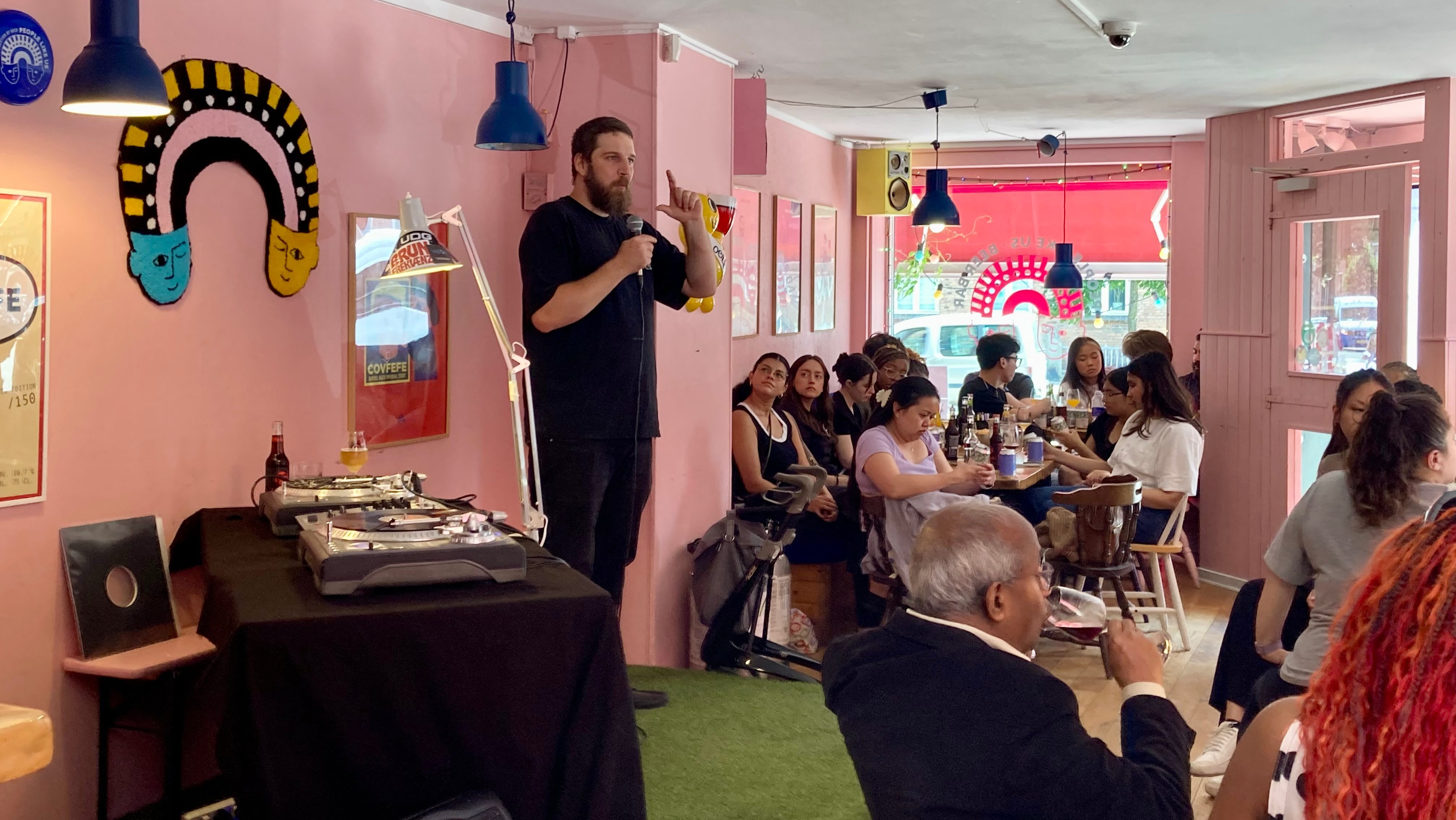
“We have Flemming in the fridge.”
Laughter fills the pink bar, where bar manager, Flemming Christensen, has his head buried in the fridge looking for non-alcoholic beer for 30 international students.
“I don’t know if I’ll ever get used to this,” says Jakob in fluent, effortless English. It’s his remark that triggered the laughter.
Jakob Møller-Jensen is 37 years old, a bartender and beer enthusiast, and he is about to explain to students from the University of Arlington in Texas how to make beer without alcohol.
Jakob has been diagnosed with bipolar disorder and PTSD, and he has had, to put it mildly, a complicated relationship with both education and working life—until he, less than two years ago, found his place at People Like Us, a brewery unlike any other.
“I joined through an internship just a few hours a week. And when it ended, I was lucky enough to be offered a permanent job,” Jakob tells the students into the microphone.
“This is the job I’ve held the longest—and the one that has kept me going,” he says:
“Here I can contribute and matter to someone. Instead of just sitting at home feeling useless.”
Ready for growth
With a workforce primarily consisting of employees with diagnoses, People Like Us has achieved near-iconic status among social impact companies.
Right now, 75 percent of the company’s employees have at least one diagnosis. In the bar on Jagtvej, the figure is 90 percent.
“We’ve cut down so we can scale up. Now we’re ready for growth.”
– Joel Haviv, Chairman of the Board, People Like Us
That recognition didn’t come easy. People Like Us has had to fight for each of its nine years of existence. Two bankruptcies bear witness to that.
But the fighting spirit remains. And now, the brewery is ready for round three.
The company has gone lean—like a beer can squeezed in the middle. But instead of stomping it flat and tossing it into the scrap, the new management unfolded, straightened, and smoothed it—sending it back into circulation, ready for another round.
“We’ve cut down so we can scale up. Now we’re ready for growth,” says Joel Haviv, Chairman and co-owner of People Like Us.
“I felt like a failure”
“The first time things really went wrong, I was 14. I cut myself, and I tried to take my own life,” Jakob recalls.
“I went into treatment. Back then, they thought I had severe depression.”
Jakob made it through primary school and started high school.
“I lasted about four months. Then I went back, handed in all my books, and said: ‘I’m not going to read another word,’” he says.
“Once again, I felt like a failure. It felt empowering to quit when I didn’t want it anymore—but it also felt like I was weird, because all my friends just kept going to school.”
Jakob tried again, got good grades, but showed up rarely. After two years, he dropped out. Only on the third attempt did he manage to finish high school.
“After that, I thought: ‘I’m so fucking smart—I better go to university,’” says Jakob.
“So I started. Lasted about half a semester… then fell back into depression.”
More than just a bar
On the tables sit cans of the alcohol-free beer Out Of Office. The name refers to the fact that 80 percent of neurodivergent people in Denmark are outside the labor market.
“Because of our focus on helping people with neurodivergence or mental illnesses, we’re aware that alcohol doesn’t always mix well with medication,” says Jakob.
Who came up with the idea of marketing alcohol-free beer to people with diagnoses, one student asks.
“Oh, it’s not really targeted at them. It’s just smart,” Jakob replies.
“It’s important for us as a company to be part of normalizing not drinking alcohol.”
That’s why People Like Us doesn’t call the bar a pub, but a “venue” or a “hub.” It’s not a place to get wasted, but a gathering space with music, pub quizzes, and geekier events like knitting circles, poetry readings, and fly-tying workshops, explains director Mette Saga.
In fact, a 100 percent alcohol-free bar is one of the cornerstones of the company’s growth strategy.
“Our strategy is to be in five places within three years. Three in Copenhagen, one in Aarhus, maybe one in Amsterdam. And one of those should be a true alcohol-free bar,” says Joel Haviv.
“I had to do things differently”
For 15 years, Jakob lived a life of trial and error.
“At some point, I had the crazy idea that maybe I shouldn’t go to school. Maybe I should just try working—like a ‘normal’ person,” Jakob says.
He got a job as a bartender at the Pumpehuset music venue and made his own music on the side.
“We toured in England and a bit around Europe. I only did things I liked. And yet, I couldn’t figure out how to overcome the dissatisfaction,” he says.
“Even when I did what I loved, I still fell into these deep, dark holes. That’s when I realized I had to do things differently.”
Jakob went to the municipality and was told to find an internship. Living near the bar, he knew about People Like Us—so he sent an email.
“I had a good talk with Flemming, and I was practically set up right away. That’s when things started to make sense. I started with just a few hours and gradually increased, depending on what I could handle,” he explains.
“It turned out I could handle more hours than I thought—but fewer than I wished. You only find that balance by testing your limits.”
Today, Jakob works 16–20 hours a week, depending on the workload.
It’s about people
Jakob’s story embodies the core of People Like Us.
“This is about people. We need to create the safest possible environment for those who’ve always struggled in the systems society provides,” says director Mette Saga.

It was stories like Jakob’s that weighed on her and Chairman Joel Haviv the day in January at the Maritime and Commercial Court.
“It was deeply uncomfortable. And it wasn’t about me. It was about the pink bar and all the people I’d worked with for six months. I felt like I was letting them down,” says Joel Haviv.
At the end of 2022, People Like Us went bankrupt, only to be revived as a cooperative with 33 owners. But in January 2025, that structure also collapsed. And so, the chairman sat in court once more.
“We looked at each other and said: ‘We have to save those jobs,’” says Haviv.
That was the start of round three.
“You have to buy five beers”
People like Jakob need a place to be. A place to belong. And a place to contribute with all their skills.
That’s what People Like Us is about. And that’s why the company not only needs to exist—it needs to grow, say Saga and Haviv.
But to grow, they must make money.
“We need to run a business. We can’t just walk around saying what we do is wonderful,” says Haviv.
“People Like Us gets a lot of love. That’s great. But it’s not enough. You also have to buy five beers—because when you do, we can hire someone else for maybe three hours a week. That’s when we become socially responsible.”
Leaned down, ready to scale
Paradoxically, growth required cutting back.
The company’s core is the same, but tasks have been consolidated, and fewer beers are brewed.
“We were too costly. So we cut right down to the bone,” says Haviv.
And a new leadership took over. Both Saga and Haviv come from strong commercial backgrounds in advertising, publishing, and media.
“With us at the helm, the organization is ready to grow,” Haviv says.
“If someone came tomorrow with the money to scale, we’d be ready the day after. We know our numbers and our people. We know where we want to go. The past six months have been about scaling down so we can scale up.”
Looking for a strategic partner
The plan is for someone to step in soon—if not tomorrow, then at least this half-year.
At the time of the January bankruptcy, People Like Us was a cooperative with 33 owners—idealists who had kept a unique company alive.
“Those idealists made People Like Us a much stronger brand than our size would suggest. But the cooperative model made it hard to attract new investors,” says Saga.
Today, the company has four owners—and is seeking a fifth.
“The dream scenario would be a large strategic and financial partner with the muscle to help us grow,” she adds.

“I want to support companies like this”
At the bar, Lois Zang from Texas asks if she can buy a T-shirt from People Like Us.
There’s none in her size, but maybe stickers?
“I’ve got some at home,” says Flemming.
“I can bring them tomorrow—if you promise to stop by.”
Lois studies business administration and dreams of a career in HR.
“I’m simply in love with Jakob’s story. I can really relate,” she says.
“My mom has a cousin who is neurodivergent. I want to be there for people like him. Help them find a place where they fit in. So I want to support companies like this one.”
A pink social unicorn
For People Like Us, growth is a necessity, explains Haviv. Each bar they open creates 30 new jobs for people with neurodivergence or mental illness.
But beyond that, the ambition is to inspire others by showing that leading people with different kinds of brains isn’t complicated.
“There’s no rocket science. It’s about seeing the individual person. If you work best after 10 a.m., we just make that fit. It’s not complicated,” Haviv says.
“And if you create that environment, you get back an enormous amount of loyalty. That’s why everyone here goes the extra mile for each other. You get so much in return.”
That’s why People Like Us must grow—responsibly, of course.
“We want to scale. But we’ve promised each other to do it sustainably. We’ll start in Denmark, creating 120 more jobs. Once we’ve nailed that, it’ll be fucking awesome to enter Berlin,” Haviv says.
“And we’re ready. We’re not talking small. We’re talking potentially huge.”
A social impact unicorn, perhaps.
“Exactly. That would be really cool. And it’s pink,” says Haviv.
“Can I function in the labor market?”
Behind the taps in the pink bar on Jagtvej stands Christoffer.
“Good to meet you,” says Jakob, giving him a fist bump on his way out—probably drained of energy after his talk.
Christoffer is 34. Like Jakob, he’s had a tough road.
Diagnosed with autism, he has gone through countless studies without finishing. Work placements haven’t worked for him either.
“They haven’t handled things the way I need. I want to find out if I can even function in the labor market,” he says.
Yesterday, he started his internship at People Like Us.
Two trendy guys are ready to order.
“Can you handle it, Christoffer?” Flemming asks.
He can. The customers get two Birch pilsners.
Hopefully, soon there will be more places where Jakob, Christoffer, and many others can settle in, grow, and contribute everything they have to offer.
In Copenhagen. Aarhus. Amsterdam. Berlin. Maybe one day, Texas.
“I’ll be back tomorrow to get my stickers,” says Lois Zang.


