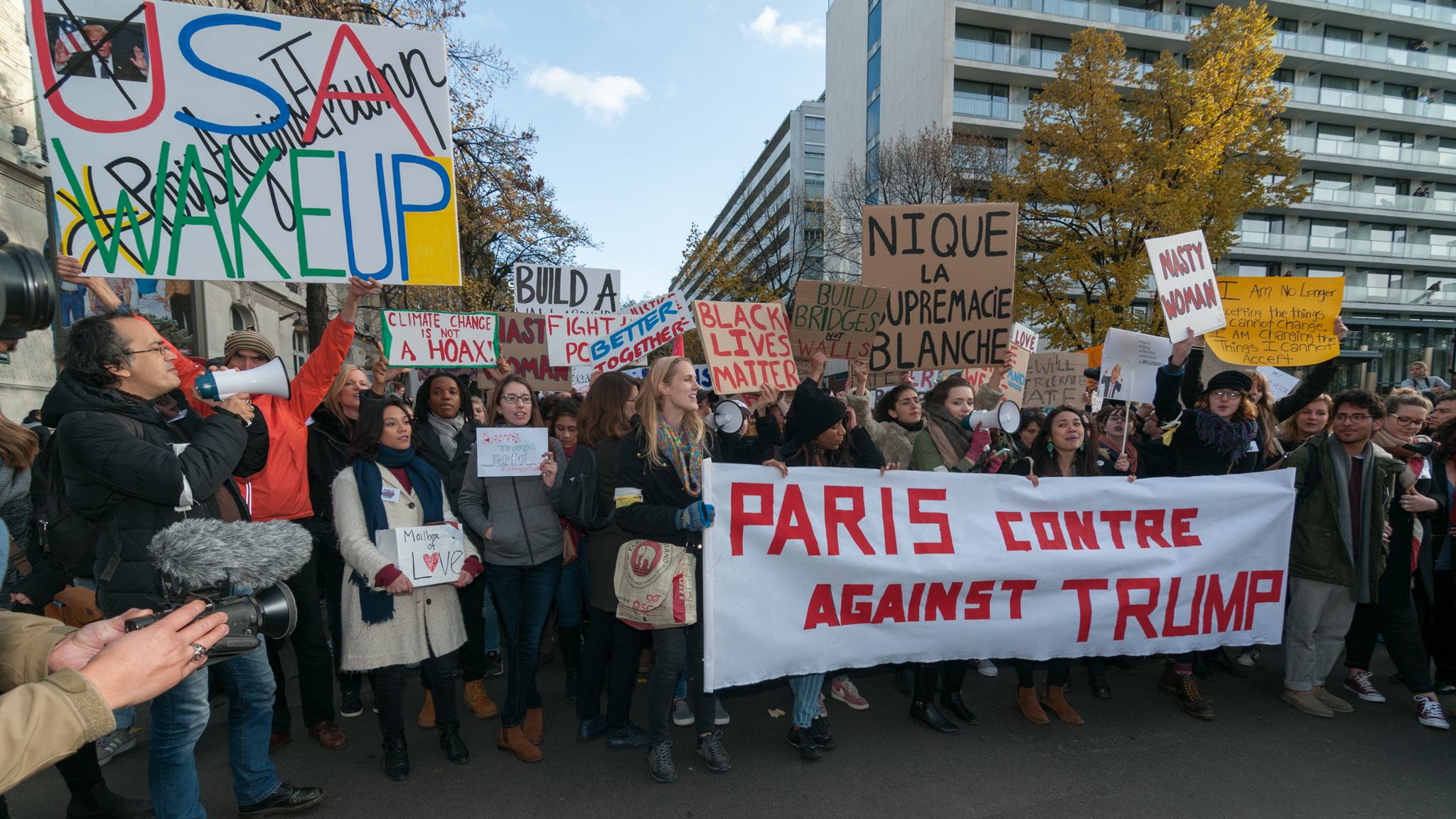
What effect does it have that President Trump is withdrawing the USA from the Paris Agreement?
This was the good and important question posed by Peter Møllgaard, Rector at Copenhagen Business School, on LinkedIn after commenting on the situation regarding the announcement by US President Donald Trump on Danish TV2 News.
Undoubtedly, this is one of the questions that thousands of politicians, business leaders, and millions of people are asking themselves these days – not least the elite gathered at the World Economic Forum in Davos at the end of January.
My immediate thought is that it is not at all decisive for the long-term green transition whether the USA is part of the Paris Agreement or not. Or whether, for example, Denmark has a unique climate law that can inspire all other countries.
It is impossible to cover all aspects of this question in a single column, but for me, the central answer is quite clear: Positive change rarely happens because of political agreements, no matter how good the intentions are.
How will the agreement be handled in the next term, and by whom? Perhaps the agreement will even be scrapped. As in the case of Trump – twice, in fact.
The Paris Agreement – and other supranational political agreements – are often much more about short-term domestic politics than global goodwill.
Change happens within people
For ten years, I have worked with sustainable innovation and business development, coaching over 300 companies (from startups in Nordic innovation environments to international companies in the EU, USA, and Asia).
I have contributed to educating entrepreneurs and business leaders on how behavioural changes are the key to companies delivering social and environmental positive impact combined with commercial success.
The commitment of these entrepreneurs to a sustainable world is not dependent on the fact that 193 countries signed the UN’s 17 global sustainability goals in 2015 or that the EU has had a taxonomy since 2019 classifying what is environmentally sustainable – followed by increasingly rigid ESG legislation.
Of course, the international agenda has influenced the entrepreneurs’ work. But fundamentally, that is not why they and hundreds of thousands of international entrepreneurs are striving to change the world for the better.
They do it because it is the only viable path for all of us.
Political signals to voters
We already know it. We need to change. Each of us. As organisations and businesses, with the help of sustainable business models as well as new societal models. Change happens within people. Not in political agreements.
I therefore do not think it is decisive for the long-term green transition whether the USA is part of the Paris Agreement or not. Not at all.
From my perspective, the 2015 Paris Agreement (which no country has met ten years later) and Denmark’s 2019 climate law (which five years later is far from being implemented – and which many, including myself, think might not ever succeed) are, sadly, mostly instruments for opportunistic politicians.
They use these agreements, global intentions as well as national laws, to retain their voter base (and their seat in parliament).
Politicians show their goodwill by signing positive visions. This gives them another good narrative to use in the current term or to bring up in future elections.
That is exactly what Trump does. He appears to retain his voter base by leaving the Paris Agreement, fulfilling what he promised voters: America First.
Just as the outgoing President Joe Biden tried to send positive signals to his Democratic voter base by re-signing the Paris Agreement on the same day he took office four years ago.
With the “Inflation Reduction Act,” Joe Biden’s administration decided in August 2022 to earmark $370 billion for green infrastructure (primarily climate investments and energy transition). Naturally, this contributed to the USA meeting parts of the Paris Agreement. But primarily, it was domestic politics.
Why else would the initiative be named with the word “inflation”?
Because inflation was, and still is, much higher on the daily agenda of the American middle class than a more sustainable world.
Positive changes in the local sphere
Of course, it will have a negative effect that the USA withdraws from the agreement. Why should India, China, and other countries with massive climate footprints change if the USA does not?
The UN and the EU are once again left with the impossible task of leading the way and ensuring that global CO2 emissions, environmental toxins, fossil extraction, and hazardous waste are reduced.
If we are to take an optimistic perspective, there is nothing wrong with Paris Agreements, global goals, or “national climate laws.” But they are by no means decisive instruments for the very necessary transition in the 21st century.
Transition requires real behavioural changes. In businesses. In the public sector. And especially among us as citizens.
If we do not take on this task and contribute to positive changes in our immediate surroundings (ourselves, our families, our municipalities, our workplaces), it does not matter how many global and national agreements are signed.
We should invest in citizens
Fortunately, there are trends indicating that more and more of us – at least here in the Nordic region – are slowly changing our behavioural patterns towards sustainability. Unfortunately, not enough. And certainly not fast enough.
Education institutions such as Copenhagen Business School in Denmark, MIT in Boston, Royal Institute of Technology in Stockholm, Tsinghua University in Beijing or INSEAD in Fountaineblue just outside of Paris, are central pivots for the world we are going to create.
We must and should invest much, much more in the long-term change: in the citizens of society.
1. We must invest oceans of money, resources and focus on our young generation, through school and leisure activities, from generation to generation, being educated in how personal, responsible behaviour towards people, society, the environment and nature leads to a better life, both for themselves and for all of us.
2. We must integrate even more knowledge, methods, skills and tools around healthy and responsible social, management and business models in our elementary schools, upper secondary schools, university colleges and universities.
This will lead to a much more profound change than political agreements can ever deliver.
Therefore, it is gratifying that, for example, Rector Anders Overgaard Bjarklev, has all the focus on green transition as part of all programs at Danish Technical University, or that sustainability and circularity are very much in the hands of both the management, the teachers and the students at the Royal Academy of Architecture, Design and Conservation in Copenhagen.
Learning will lead to transition
When “green transition” is no longer a task that we all must solve, but living and acting sustainably becomes a natural part of our behaviour as citizens, as a nation, sustainability will be the basis for all the contexts we are involved in on a daily basis. No matter how ignorant the politicians who at times lead e.g. Denmark, the EU, the USA, China, India, the UN and the WTO are.
As Danes, and as humans, we have very little influence on who wins elections in individual nation-states or gains power in supranational organizations.
Let’s concentrate on what we can influence – that we all learn much more about how we can change our own behaviour and influence the contexts we are a part of.
If we invest in learning, I believe that the transition will happen by itself, and suddenly, a few generations down the line, we will be living in a much more sustainable, responsible, and perhaps even regenerative world.
The key answer to the good and important question that rector Peter Møllgaard at Copenhagen Business School and many others ask themselves in this peculiar time, where Donald Trump issues one incredible executive order after the other, must be that sustainable transition happens through personal responsibility, education, and learning – not global politics.
Richard Georg Engström has worked in technology, business, and finance since the mid-1990s. Over the past ten years, he has advised and invested in startups with sustainable solutions and provided guidance on impact investments.
In 2017, Richard founded the company Impact Business Modelling System, which has assessed close to 10,000 Nordic and European impact startups and coached more than 500 in making their impact measurable and operational.