2025 will be remembered as the year that it became impossible to ignore the fault lines in our society. And a year when new forums for change brought leaders from all sectors together to co-create solutions to the world’s most urgent challenges.
Despite GDP growth and rising stock indices, prosperity is illusionary for all but the most privileged people. Today, just 0.001% of the global population, about 56,000 people, hold three times the wealth of the poorest half of humanity, according to the World Inequality Report 2026. As the rest of us grappled with rising costs, billionaires increased their fortunes by an astonishing $2 trillion, according to Oxfam. In the United States, 57% of adults are living paycheck to paycheck. What kind of “prosperity” is it when economic growth leaves most of the country unable to cover a $400 unplanned expense?
Generative AI’s impact continued to be transformative in ways that are both positive and challenging. Automating tasks and efficiency across industries like healthcare, finance, and creative fields contributed to boosting productivity and innovation. It also displacied jobs, increased energy consumption, and was a source of misinformation, according to the U.S. Government Accountability Office. A study by the World Economic Forum estimated that 92 million jobs could be displaced by AI worldwide by 2030 – though potentially more new roles will be created in return.
In democracies around the world – including those long seen as stable, such as Canada or the Netherlands – extremist voices, fueled by social media, gained ground, feeding on economic grievance and cultural backlash. An annual global trust survey this year found a majority of young adults now see force as justified to advance their political aims, according to the 2025 Edelman Trust Barometer.
Global carbon emissions have hit a record high and every measure of climate progress is behind schedule. Not one of the 45 key climate indicators tracked in a major “State of Climate Action” report is on pace to meet 2030 targets. Scientists have warned that the remaining carbon budget for the 1.5°C warming limit is now “virtually exhausted”.
The last few months of the year offered a glimpse of hope.. President Trump’s approval ratings have fallen, the Republican Party has lost elections, and Lower-court judges, including some appointed by Mr. Trump, have blocked some of his policies and called out his disregard for truth.
New Collaborations for Change
2025 taught us that progress is not assured. It also created an opening for a new approach to societal change where leaders from all sectors collaborate to develop innovative ways to solve social problems and commit to taking action. Five initiatives from last year demonstrate what’s possible.
The 2025 SDG (Sustainable Development Goal) Global Business Forum convened leaders from business, government, civil society and showcased innovative solutions from countries including Finland, Ghana, India, Indonesia, Nigeria and Switzerland. The Forum featured action-oriented discussions on enabling policies, principled partnerships, and locally co-created innovations informed a set of takeaways for scaling private-sector SDG impact.
At the AI for Good Global Summit 2025 in Geneva, more than 800 speakers from across all sectors and 10,000 attendees including AI experts, tech industry, government policymakers, social innovators and UN agencies co-created AI solutions for people, planet and prosperity. Participants built new partnerships, made commitments to “AI for Good” projects, and demonstrated how multi-sector collaboration in technology can accelerate multiple SDGs.
The Sustainable Innovation Forum 2025 in São Paulo, Brazil, connected governments, corporate and finance leaders with innovators and problem-solvers who are delivering climate solutions on the ground. The event strengthened private-sector commitments to climate solutions and facilitated new collaborations aimed at scaling up decarbonization and climate-resilient projects.
The Africa Regional Forum on Sustainable Development in Kampala, Uganda engaged government leaders, African Union officials, UN agencies, the private sector, youth representatives, and researchers on Decent Work & Economic Growth in an African context. Participants adopted the Kampala Declaration, a regional roadmap of bold, science-based and inclusive actions to scale up job creation, strengthen health systems, advance gender equality, promote green industrialization, and bolster partnerships.
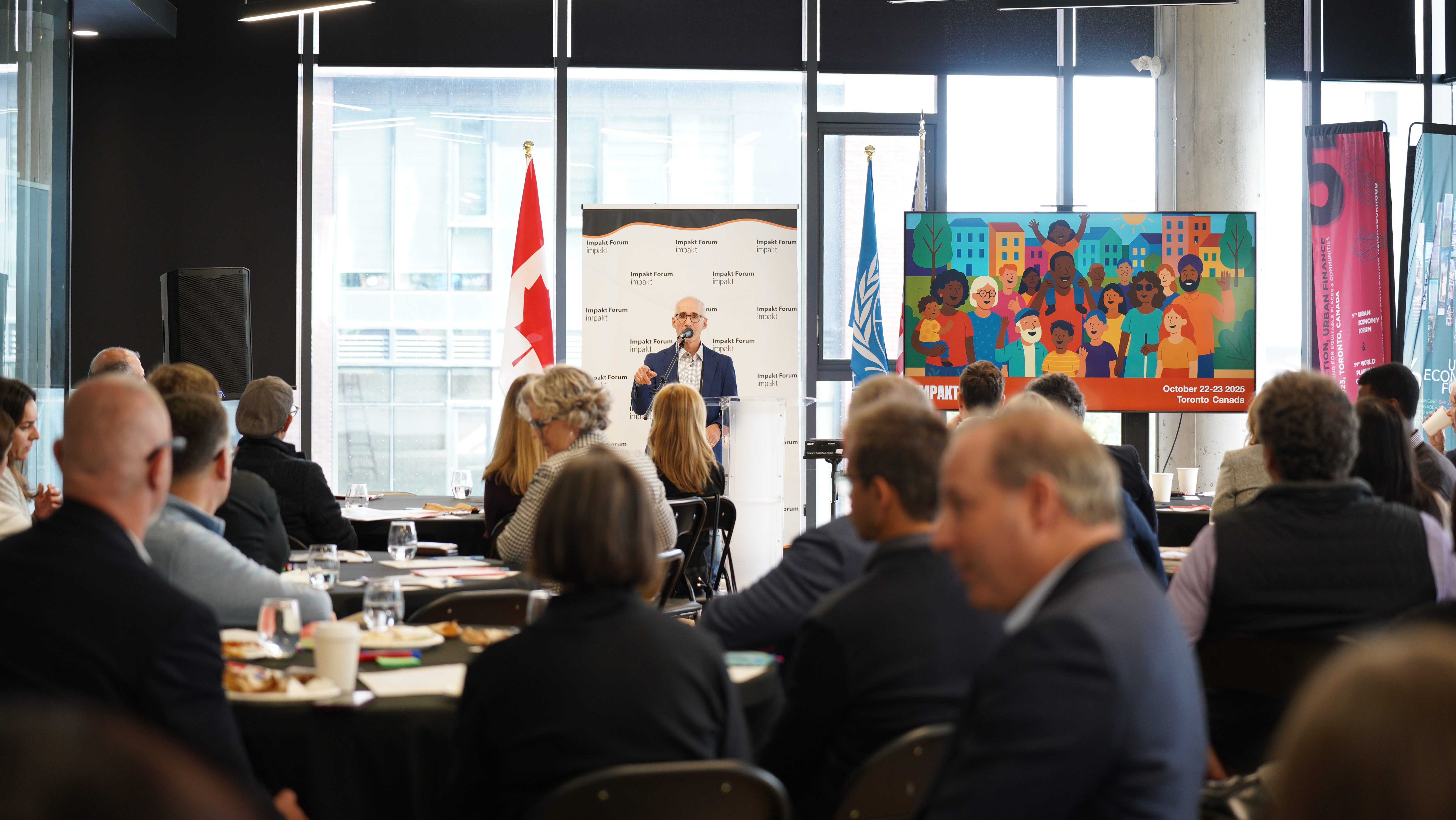
The inaugural Impakt Forum in Toronto created an opportunity for business, civil society, academic and lived experience leaders to co-create actionable solutions to SDG 11.1: affordable housing for all. Pilot projects conceptualized by participants will be implemented by a Toronto Working Group and shared at the next Impakt Forum in the fall of 2026. This year’s Impakt Forum is the start of a five-yearjourney leading up to 2030, with annual gatherings in a different city each year where leaders will co-create new pilot projects.
New Operating System for Social Change
Each of these initiatives demonstrates that leaders from all sectors have an appetite to collaborate, co-create and act. Moving forward, new models need to reflect internationally recognized human rights standards, ensure everyday decisions help maximize resources for public health, education, and economic, social, and cultural rights, avoid any exclusions that exacerbate inequalities, and include the perspectives of people with lived experience.
“No single sector can solve the affordable housing crisis… meaningful change depends on more collaboration between public, private, nonprofit, community partners and people with lived experience,” wrote three co-authors of Why Affordable Housing Starts with Listening to Those Who’ve Lived It, each of whom has experienced housing insecurity firsthand. Their message doesn’t just apply to affordable housing. It applies to everything from climate change to public health.
The success of the SDG Global Business Forum, AI for Good, the Sustainable Innovation Forum, the Africa Regional Forum point to a new operating system for social change that engages leaders and has the potential to deliver massive change – before it’s too late.
Paul Klein is the founder of Impakt and the Impakt Foundation for Social Change. He is the author of Change for Good: An Action-Oriented Approach for Businesses to Benefit from Solving the World’s Most Urgent Social Problems.