Knowledge creates action.
That assumption forms a cornerstone of our efforts to solve wicked problems such as climate change, biodiversity loss and inequality.
But the assumption is wrong. And that means that many of the initiatives we design, fund and communicate start in the wrong place.
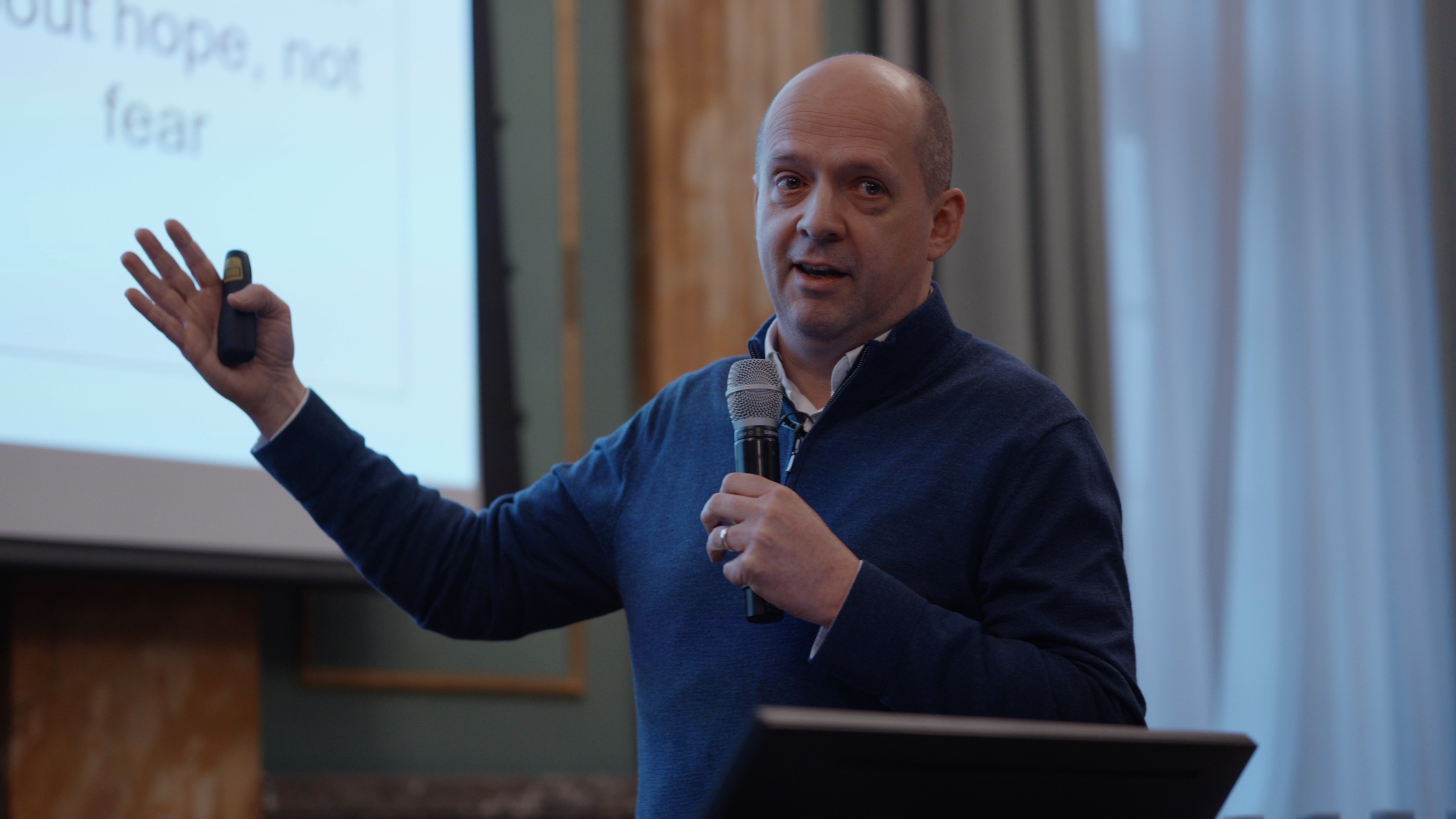
That is the assessment of Kris De Meyer, neuroscientist and Head of the Climate Action Unit at University College London.
“There seems to be a kind of ingrained, conventional wisdom that information and awareness drive change – that you need to change something inside a person’s head in order to change their behaviour,” he says.
But in fact, the relationship is reversed, argues Kris De Meyer, pointing to research from psychology, sociology – and more recent neuroscience.
“The causality is actually almost the other way around. It is what we do that changes what goes on inside our heads.”
Why action creates attitudes
In other words, it is not attitudes that create action, but action that creates attitudes.
According to Kris De Meyer, this is primarily due to two mechanisms in the brain.
One of them is the concept known in psychology as cognitive dissonance.
“When we make a decision or take an action, it puts us in a state where we feel a need to justify to ourselves that what we have done is important,” he says.
Psychologists became aware of this phenomenon as early as the 1950s.
“They began to see that it could be easier to get people to do something – after which they would adjust their beliefs and attitudes – than the other way around,” says Kris De Meyer.
This mechanism is particularly strong in areas where we do not yet have established routines. But once we begin to act, something happens.
“When people start acting, the need for self-justification kicks in,” he explains.
That process can lead in different directions – including down a rabbit hole, where one action reinforces the next in destructive communities. But it can also set a positive spiral in motion.
“You might start thinking: ‘How can I take the next step, now that I’ve acted, learned from it, and experienced that it mattered to me?’” he says.
The second mechanism relates to the social reward that can follow an action, says Kris De Meyer.
“When we do something for the first time, someone might look at it and say: ‘Hey, that’s really good what you’ve done. We should do more of that.’”
It is both self-reinforcing and inspiring.
“Others can look at us and say: ‘If you can do it, then I can too.’”
We bury people in data
Despite the insights researchers have gained over the past 70 years, we continue to bury people in data – often wrapped in bleak narratives of decline – when we talk about complex societal problems.
The result is often attention – but not action.
Climate communication is a good example of this, Kris De Meyer points out.
“When it comes to climate, we communicate in that way of: ‘If you don’t act, we’re all going to die,’” he says.
In his view, this applies to perhaps 95 percent of communication about climate, biodiversity and other wicked problems.
“We keep talking at a level where we say: ‘There is a big problem. Can’t you see that there is a big, big problem?’” says Kris De Meyer.
And that quite simply does not work, he stresses.
“We know that negative stories do not lead to change.”
We need to inspire change
If we want to change the big picture, we need to use different tools, Kris De Meyer argues.
We need to equip people with tools for action and show them that it is actually possible to change the state of things.
Paradoxically, we already do this – just not when we report on wicked societal problems.
“There are many very specific contexts where communicators actually do the right thing and tell stories about people taking positive action. But often they do not see these as stories that are meant to create change,” he says.
As an example, he points to the sports pages.
“You can find profiles of football players and the story of how they became stars. These are told as action stories,” says Kris De Meyer.
“It’s not necessarily that anyone thinks: ‘This will create change.’ But they may well have an implicit idea that these stories can inspire young people who are struggling to overcome adversity.”
Those are precisely the kinds of stories we forget to tell when we communicate about climate and environmental crises.
“We tend to make those stories issue-based – instead of telling a series of actions that can inspire others to do something effective,” says Kris De Meyer.
Knowledge is not irrelevant
The point is not that knowledge is irrelevant, Kris De Meyer emphasises.
But the type of knowledge we often lack is different from the kind we tend to provide.
“There is still a need for knowledge. But often it is knowledge about how to act – rather than a deep need for knowledge about the problem itself,” he says.
For example, we do not constantly go around telling people that eating unhealthy food is deadly.
“We might do that sometimes in nutrition campaigns. But most of the time, we show people how to cook healthy food that is tasty and good for your health.”
As an example, he mentions the English celebrity chef Jamie Oliver.
When Oliver launched his campaign for better school meals, his approach was not to shame school canteens for serving bad food.
“Instead, his approach was to show how the women cooking the food in schools could prepare healthier meals for the same amount of money,” says Kris De Meyer.
The problem is not only in the media
The habit of lecturing communication is not just a media phenomenon, Kris De Meyer points out.
“It’s about how we all behave – also in the conversations you have with people around you and in your family,” he says.
Kris De Meyer recounts that he was once asked by a vegetarian how they should explain and justify their choice to their family.
Broadly speaking, he replied, there are two approaches.
“You can say: ‘You should become vegetarian because it’s really good for the planet, and it’s bad for animal welfare that you eat meat,’” he says.
And then there is the other approach.
“You can say: ‘I’ve really thought carefully about whether I should do something for the sake of the planet. I wasn’t sure, but in the end I tried it. And now I’m vegetarian. And I actually feel much better.’”
That does not necessarily mean you convince others, Kris De Meyer concedes.
“But at the very least, you won’t create as much resistance. And then you might inspire someone else to take a new step. That doesn’t happen if you start by pointing fingers.”
Let the snowball roll
On a larger scale, there is no guarantee that more inspiration and less doom in communication will lead to major change.
“It doesn’t work in the sense that a particular action becomes meaningful to you because I tell you it is meaningful to me,” says Kris De Meyer.
“But if I tell my story to a hundred people, maybe one or two or three will think: ‘Hey, I hadn’t thought about that. I could also do something differently.’”
That is why we should see societal change as the sum of many actions.
“If we tell enough of these stories across all the things that matter to each of us in our lives, we begin to see that snowball effect that can create societal transformation,” says Kris De Meyer.
In marketing, he notes, there is a clear understanding of how the brain works.
“Marketers have implicitly – if not explicitly – figured out how this works. And they use it to sell us more things. But many people working with social change have missed this. And that’s why we don’t see the impact of our good intentions,” he says.
An embedded scaling model
But if there is no guarantee that individual actions can trigger an avalanche, does our belief in societal change rest on a very fragile foundation?
No, says Kris De Meyer, because small, positive actions contain an embedded scaling model.
“In fact,” he says, “it’s not about small versus big. It’s about the possible versus the overwhelming.”
A possible action might be a manageable project with a single organisation or a small group of people in a local community.
“Once you’ve made a manageable change, you begin to see how you can do more. And over time, your perception of what is possible to change grows,” says Kris De Meyer.
For foundations, authorities and organisations, this means that change should not be designed as messages – but as actions that can be repeated, expanded and copied.
“From the outset, you can build into your model the idea of how to imagine the scaled-up version of what has already been created,” says Kris De Meyer.
He mentions that he himself has been involved in one collaboration that started with a single local school authority. Today, that effort has expanded to ten authorities across London.
“We learned by operating in one context. We took that learning with us, and today we have ten times the impact we had at the beginning,” he says.
That is why he is not concerned about starting small.
“Start with something that lies within your sphere of control. And gradually, your sphere of control will expand,” says Kris De Meyer.
He also encourages people to keep the faith – even under pressure to demonstrate results.
“Societal change requires patience and stubborn persistence. When you know what you’re doing, and you keep going, there will come a moment when the penny drops, and it becomes clear that your effort is paying off,” says Kris De Meyer.