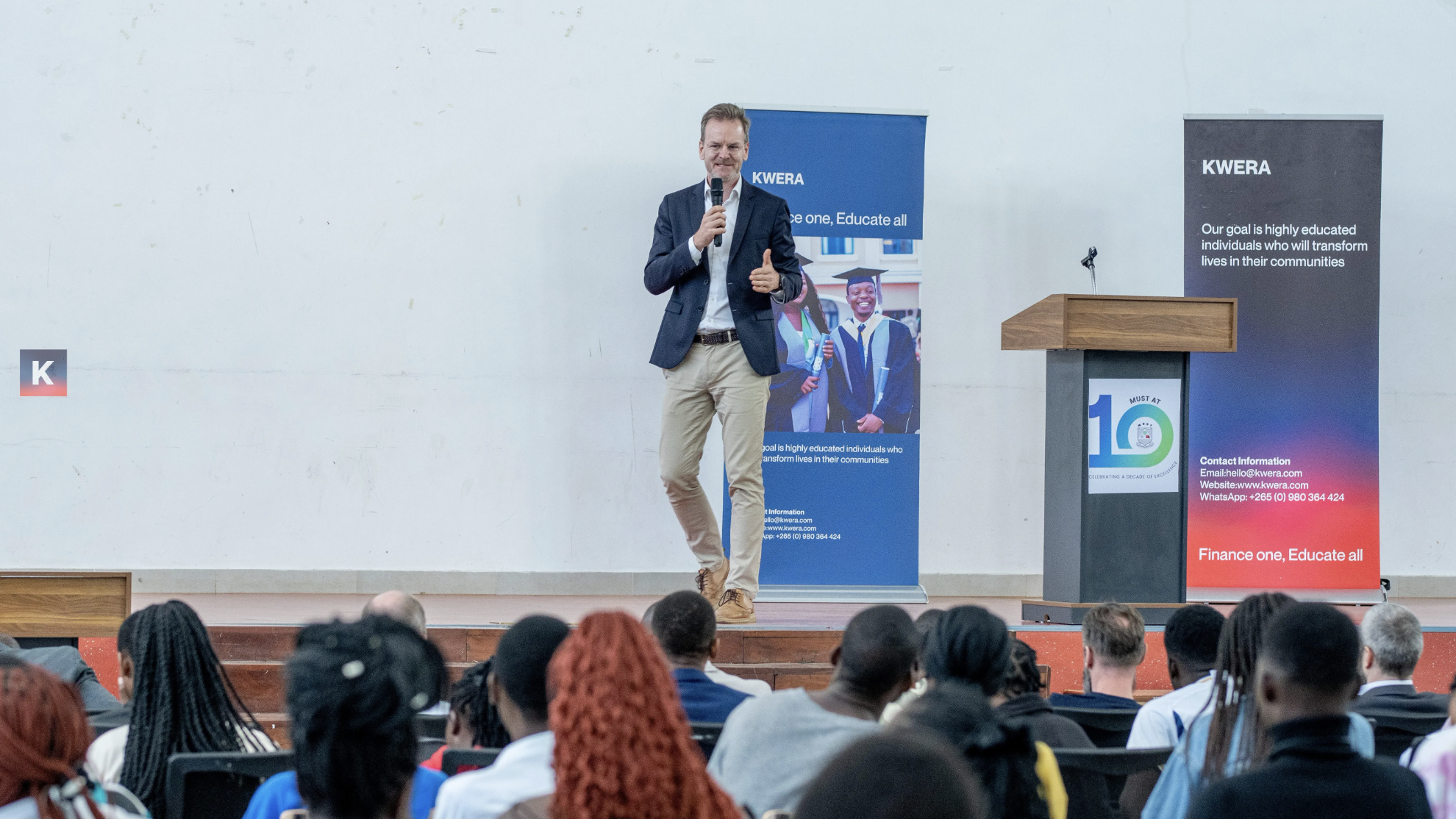
“In a low-income country like Malawi, you can’t educate unlimited numbers of students. They also need something to do,” says Henrik Horn Andersen.
Henrik Horn Andersen is a Senior Partner and board member at Implement Consulting Group. In just a few words, he captures why Implement – together with the organisation Kwera – is now launching an incubator and accelerator programme in Malawi: the Kwera Start-up Climber Programme.
From August this year, students supported by Kwera at higher education institutions in Malawi will be able to supplement their degree programmes with voluntary entrepreneurship studies. And those who feel called to start their own business can extend their studies by joining a six-month accelerator programme.
“We want to help create the jobs that make it possible for young people to go out and contribute to building even stronger societies – in Malawi, Tanzania, or any of the other countries where Kwera is active,” says Henrik Horn Andersen.
Education cannot stand alone
Regular Impact Insider readers may remember Kwera—the organisation founded by Danish entrepreneur Jimmy Scavenius, with an ambition to educate one million young Africans.
Education is the universal key that starts the engine of development in any society, he believes.
“In Denmark, we don’t understand how important education really is. We take it for granted,” says Jimmy Scavenius, continuing:
“Sustainable Development Goal number 4 – quality education – should be the sun that everything else revolves around. Without education, nothing happens.”
But as Henrik Horn Andersen points out so precisely, education cannot stand alone. If there are no jobs afterwards, it becomes a dead end.
Jimmy Scavenius realised this already while studying for the MBA that became the foundation of Kwera’s business plan.
“There aren’t enough jobs. So if we want growth and prosperity, we need to create more jobs,” says Jimmy Scavenius:
“We have these young people with us for four years while they are studying. That’s a golden opportunity to see whether they have the entrepreneurial gene it takes. And if they do, they need nurturing.”
An entrepreneur at heart
Henrik Horn Andersen shares that analysis.
Since the beginning, Implement has supported Kwera pro bono, helping with communication, financial analysis, and strengthening the organisation’s sales efforts. Quite early on, conversations began about building an incubator and accelerator programme, he recalls.
“I challenged Jimmy by saying we needed to carefully select the students who have an entrepreneur in them – and teach them how to raise capital,” says Henrik Horn Andersen.
“It has to be an incredibly attractive offer—something that helps young people build something that can scale,” he adds.
He illustrates this with a simple exercise he carried out at an awards show, where he presented the new programme to around 700 Kwera students:
First, Henrik Horn Andersen asked everyone who worked—or had worked—in a startup to stand up. Around half of them did.
Then he asked how many of those ran a small business of their own. Now only about a third to a quarter remained standing.
Finally, he asked how many were running a company with one or more employees while still studying.
“Maybe ten were left standing. And eight of them were women,” says Henrik Horn Andersen.
Those are the students he wants to recruit into the accelerator programme.
“This cannot turn into a fallback education for people who can’t find jobs. It has to be an incredibly attractive offer that helps young people build something that can grow to real scale,” says Henrik Horn Andersen.

A sea of startups
Implement is behind the new startup programme.
The incubator track is a voluntary offer for students in the final year of their studies. In a three-month programme, they learn how to understand customers, how to build a business model, and which solutions can work in the market.
The programme is designed to give students a clear understanding of what entrepreneurship involves – and enable them to assess whether it is something they want to pursue.
If it is, they can apply for admission to the accelerator track.
There, they are paired with a mentor, and over the following six months, they can work deeply on their business idea, understand the market, develop a strategy for bringing their product or service to market, and ideally build a proof of concept.
At the end, they pitch to a group of impact investors and raise seed capital for their entrepreneurial journey.
“It can create a whole sea of startups that can become scaleups – and then established companies. It can create so many jobs and contribute to the growth Malawi needs,” says Jimmy Scavenius, adding:
“And imagine how beautiful it could become when Kwera is operating in ten countries.”
No dreams of unicorns
For Henrik Horn Andersen, it is crucial that the new programme does not become a project imposed on young Africans from the outside. It must be built in close collaboration with local partners.
That is why Kwera and Implement are now working on a partnership with Standard Bank, Malawi’s largest bank, which is expected to provide facilities for the programme and offer loans to the emerging entrepreneurs.
“It’s extremely important that we don’t sit here thinking we already know what it takes in Malawi. You need to understand the local context,” says Henrik Horn Andersen.
If we dare to dream really big, it could become the fundraising wheel that means we never have to fundraise for Kwera again.
That is also why he and Jimmy Scavenius are not dreaming of unicorns. The ambitions lie somewhere else entirely.
“We’re not here to create the next Google or Facebook—we’re here to create what is needed,” says Jimmy Scavenius:
“It could be something as simple as a land surveying company, which there is a huge demand for. We need to be realistic.”
The programme will be housed in an impact fund
Jimmy Scavenius and Henrik Horn Andersen expect that the new African ventures will be able to attract investment from both local and international impact investors.
“You could imagine an IT startup that can code in Python. There is demand for that. And perhaps there could be impact investors back home who find that interesting,” says Henrik Horn Andersen.
That is why the new setup will include an impact fund, which can invest in the upcoming startups, Jimmy Scavenius explains.
“If we invest in 100 startups, 70 will not go well, 20 will do okay, and 10 will do really well. Those ten will make sure there is a return to reinvest,” says Jimmy Scavenius.
If things go well enough for the fund to generate returns for investors, his plan is that 25% of the profits should go to Kwera.
In this way, he hopes to create a loop where the impact fund helps finance the education programme that the entire initiative is built on.
“If we dare to dream really big, it could become the fundraising wheel that means we never have to fundraise for Kwera again,” says Jimmy Scavenius.
Helping them back onto the road
Implement has a social impact strategy. In short, it is about enabling people to create lasting and scalable change in their local communities.
With that in mind, it has been a powerful experience for Henrik Horn Andersen to be in Malawi.
“Everything is green and beautiful, and they can grow every fruit in the world. You meet so many smart people. And yet they are so poor. There is potential here that would be amazing to unleash,” he says.
It is as if there is an open highway – but young people have been driven off the road and into the ditch.
“They don’t have the resources to get themselves out. But if you can help them back up, they’ll figure out how to get that bicycle or moped or car moving forward at full speed,” says Henrik Horn Andersen.
Jimmy Scavenius adds:
“We need to create growth built on the right mindset. We need to build something that is self-financing. It has to be based on business terms rather than aid. I believe we can create something scalable together.”